My personal design philosophy consists of 3 pillars:
Develop products that people love. Products should go beyond just solving problems. Great products engage and inspire the user.
Use design to bring a vision to life. When a team is inspired by a vision, you can see it in the product. I prefer a design-driven approach, as it has yielded some of the most compelling products I have ever helped build.
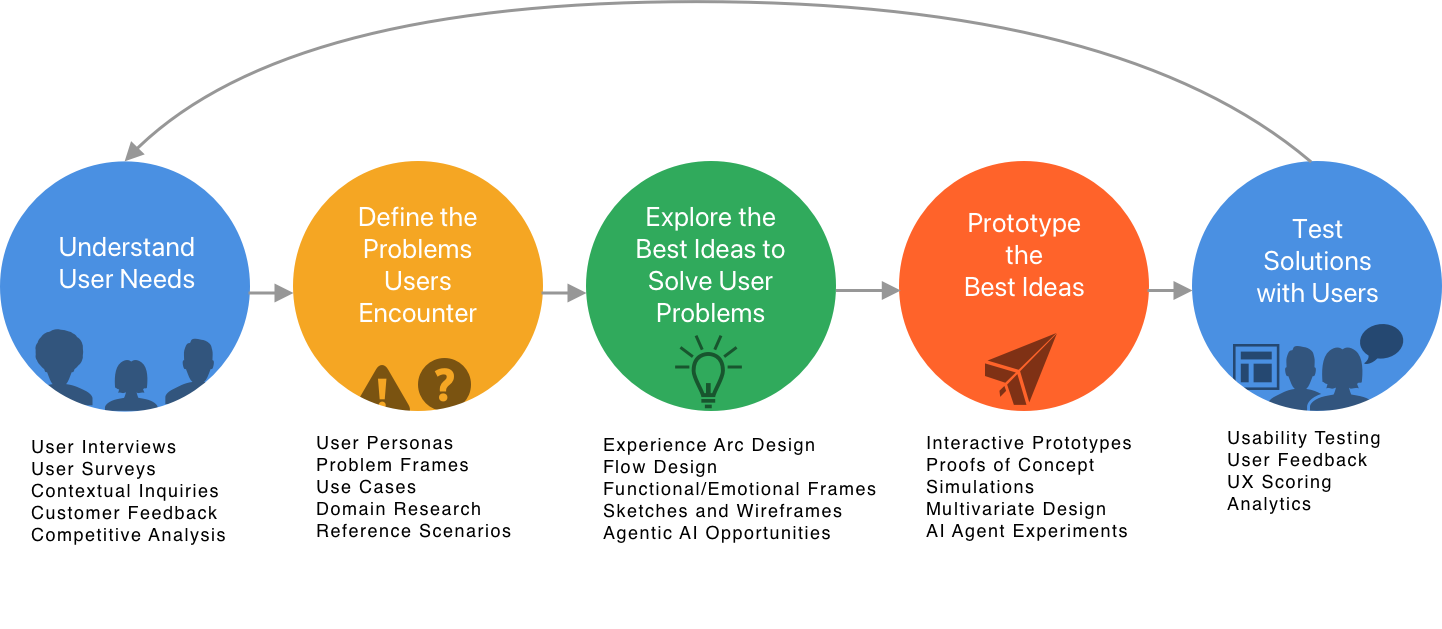
Enlist proven methodologies. My approach is influenced by the Double Diamond process and the Design Thinking framework.
Double Diamond Process Ensures
effective Time-Bound Delivery
effective Time-Bound Delivery
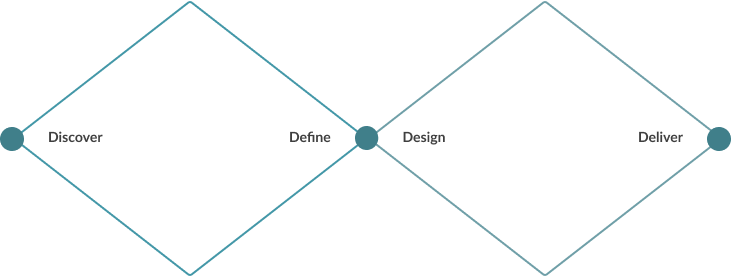
I have found the Double Diamond process pioneered by the British Design Council to be effective for delivering high-quality designs within a predictable timeframe. This process includes discrete phases that alternate between divergent and convergent activities:
Discover. We build a detailed understanding of the problem space we are addressing for our users. During this phase we diverge along multiple paths to explore dimensions of the problem to gain a rich understanding of the opportunity. Activities may include market or domain research, analytics review, user interviews, or usability testing.
Define. Once we have a solid understanding of the problem space, we converge to focus on dimensions of the problem most likely to yield the best outcomes as we design a solution. Activities may include user interviews, conceptual model validation, terminology testing, directional design validation.
Design. With our focused understanding of the problem and opportunities, we diverge along multiple design paths to uncover the best approach. We get feedback from users to validate our thinking and we engage cross-functional partners to ensure feasibility of design approaches. Activities may include prototyping, usability testing, user feedback, design system alignment, negotiation with engineering, among other activities.
Deliver. Once we have validated our design approach with users and cross-functional partners, we converge on the final design that will be produced. Activities may include creation of design artifacts, design system alignment, scheduling and resource planning for final delivery.
Above All, Design thinking
As designers we must internalize the principles of design thinking to ensure that we are always clear on the purpose of our actions. Where are we in the process? Which artifacts may be most useful at this phase? I find the Design Thinking framework is a good way to understand where we are in the process. There is a natural progression this framework offers that is easy to internalize and operationalize. This core set of principles is embedded in any effective design process.